近日,根据IEEE Xplore数据库实时显示,进化计算领域顶级期刊《IEEE Transactions on Evolutionary Computation》(IEEE TEVC)首页的Most Cited论文列表中,我课题组共有两篇论文上榜。两篇论文均为课题组在约束多目标优化方向的研究成果,充分彰显了课题组在约束多目标优化领域的研究实力与国际学术影响力。
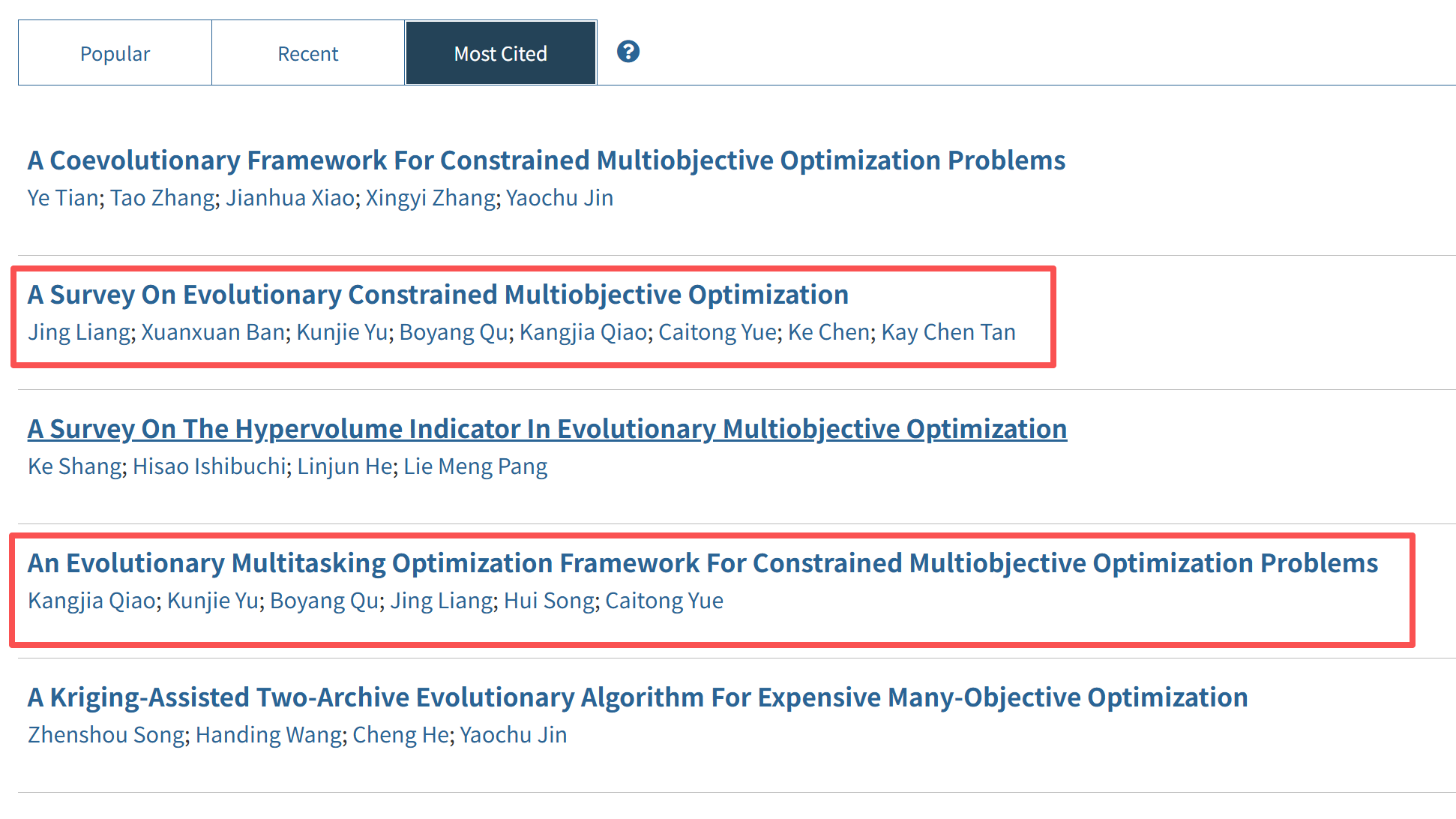
本次入选的两篇论文详细信息如下:
1. 第一篇论文发表于2022年,是一篇关于进化约束多目标优化的综述文章。该论文从约束处理技术、约束多目标进化算法、测试集及实际应用等多个维度,系统梳理了该领域的最新研究进展,并展望了未来发展方向。该论文入选ESI高被引论文和热点论文。
题目:A Survey on Evolutionary Constrained Multiobjective Optimization
作者:Jing Liang, Xuanxuan Ban, Kunjie Yu*, Boyang Qu, Kangjia Qiao, Caitong Yue, Ke Chen, Kay Chen Tan
摘要:Handling constrained multiobjective optimization problems (CMOPs) is extremely challenging, since multiple conflicting objectives subject to various constraints require to be simultaneously optimized. To deal with CMOPs, numerous constrained multiobjective evolutionary algorithms (CMOEAs) have been proposed in recent years, and they have achieved promising performance. However, there has been few literature on the systematic review of the related studies currently. This article provides a comprehensive survey for evolutionary constrained multiobjective optimization. We first review a large number of CMOEAs through categorization and analyze their advantages and drawbacks in each category. Then, we summarize the benchmark test problems and investigate the performance of different constraint handling techniques (CHTs) and different algorithms, followed by some emerging and representative applications of CMOEAs. Finally, we discuss some new challenges and point out some directions of the future research in the field of evolutionary constrained multiobjective optimization.
2. 第二篇论文发表于2022年,提出了一种基于进化多任务的约束多目标优化框架,通过约束分解的方式提升求解效率。该论文入选ESI高被引论文,相关代码已在课题组官网(https://www5.zzu.edu.cn/cilab/yjfxjkycg/ysdmb.htm)和进化计算平台Platemo(https://github.com/BIMK/PlatEMO)上公开。
题目:An Evolutionary Multitasking Optimization Framework for Constrained Multiobjective Optimization Problems
作者:Kangjia Qiao, Kunjie Yu, Boyang Qu, Jing Liang*, Hui Song, Caitong Yue
摘要:When addressing constrained multiobjective optimization problems (CMOPs) via evolutionary algorithms, various constraints and multiple objectives need to be satisfied and optimized simultaneously, which causes difficulties for the solver. In this article, an evolutionary multitasking (EMT)-based constrained multiobjective optimization (EMCMO) framework is developed to solve CMOPs. In EMCMO, the optimization of a CMOP is transformed into two related tasks: one task is for the original CMOP, and the other task is only for the objectives by ignoring all constraints. The main purpose of the second task is to continuously provide useful knowledge of objectives to the first task, thus facilitating solving the CMOP. Specially, the genes carried by parent individuals or offspring individuals are dynamically regarded as useful knowledge due to the different complementarities of the two tasks. Moreover, the useful knowledge is found by the designed tentative method and transferred to improve the performance of the two tasks. To the best of our knowledge, this is the first attempt to use EMT to solve CMOPs. To verify the performance of EMCMO, an instance of EMCMO is obtained by employing a genetic algorithm as the optimizer. Comprehensive experiments are conducted on four benchmark test suites to verify the effectiveness of knowledge transfer. Furthermore, compared with other state-of-the-art constrained multiobjective optimization algorithms, EMCMO can produce better or at least comparable performance.