WCCI'26 Competition: Higher Dimension Multimodal Multiobjective Optimization
2026 IEEE World Congress on Computational Intelligence (WCCI 2026)
Conference dates: June 21th to 26th 2026 Maastricht, Netherlands
Organizers
Jing Liang, Zhengzhou University, China
Caitong Yue, Zhengzhou University, China
Kunjie Yu, Zhengzhou University, China
Ying Bi, Zhengzhou University, China
Hui Song, RMIT University, Australia
Results:
The scores of the entries are as follows. The top three will be awarded the first, second, and third prizes respectively! Congratulations to the winners, and thank you for your active participation!
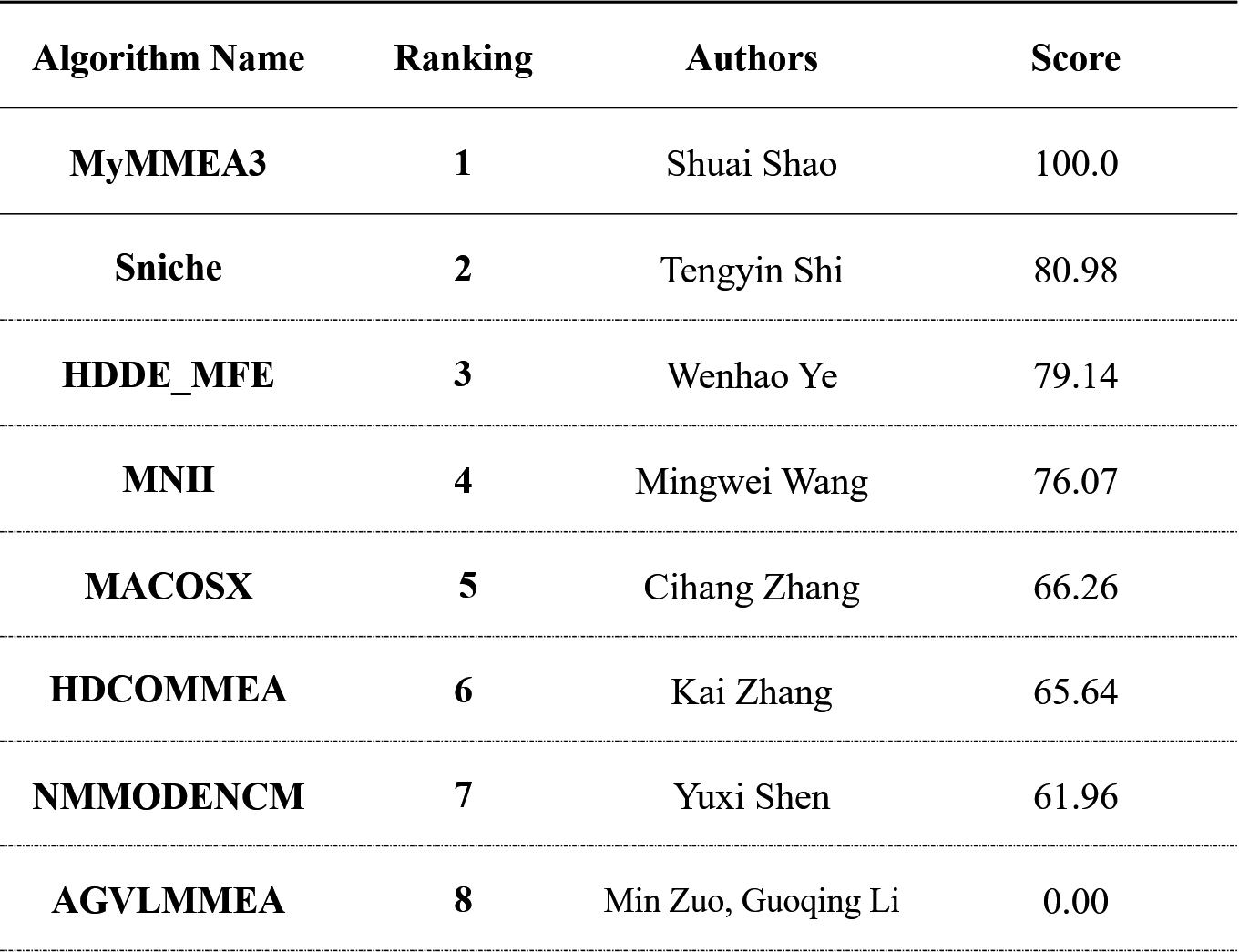
The organizers have verified the submitted results and source codes of all participants. The code will be uploaded to the website after obtaining authorization from the participants. As some papers related to these algorithms may not have been published yet, the codes are temporarily not released to protect the privacy of the algorithms. They will be published after the papers are accepted by relevant publishers. If you are interested in these algorithms, please contact the authors directly.
Remarks:
For questions about the competition results, please contact Dr. Caitong Yue: yuecaitong@zzu.edu.cn. If you are interested in a specific algorithm, please contact the corresponding authors listed in the result table directly.
Introduction
Over the past decade, there has been rising interest in research on multimodal multiobjective optimization. This is a challenging yet highly important topic that addresses problems with multiobjective and multimodal characteristics. In many real-world applications, such as large-scale structure design, scheduling, and machine learning, optimization tasks routinely involve tens to hundreds of decision variables and often possess two or more distinct Pareto optimal sets (PSs) in the decision space.
Such multimodal multiobjective optimization problems (MMOPs) imply that multiple equivalent PSs may correspond to the same Pareto front (PF). However, existing multimodal multiobjective evolutionary algorithms (MMOEAs) are primarily evaluated on benchmark problems in which the number of decision variables is limited to a very small scale, usually from 2 to 10. Therefore, their comprehensive performance may not be fully evaluated, particularly their convergence performance in the objective space and their diversity performance in the higher-dimensional decision space. Consequently, it is necessary to investigate higher dimension multimodal multiobjective optimization with these characteristics.
Broadly speaking, higher dimension MMOPs bring about at least three main challenges. First, the high dimensionality of the decision space makes it difficult to maintain diversity around multiple equivalent PSs. If a population only converges to one PS, decision makers may lose alternative solutions with the same objective-space quality but different decision-space properties. Second, multimodality makes the relationship between the decision space and the objective space more complex, because good PF approximations do not necessarily imply good coverage of multiple PSs. Finally, algorithms must balance convergence toward high-quality objective values and diversity across higher-dimensional PSs under limited computational budgets.
These challenges underline the need to develop more complex and comprehensive test problems. Doing so will encourage the creation of innovative methodologies for higher dimension MMOPs and provide a fair platform for evaluating the objective-space and decision-space performance of MMOEAs.
Competition Guideline
In this competition, multiple sets of MMO test problems with different properties are presented. These include problems with tens to hundreds of decision variables whose Pareto fronts are associated with multiple equivalent PSs in the decision space, problems whose PSs differ in shape and spread, and problems whose decision-space and objective-space dimensions are scalable. In addition, fair evaluation criteria and reference data are provided to assess the performance of different MMOEAs.
Through suggesting a set of benchmark functions with a good representation of higher dimension multimodal multiobjective characteristics, we aim to promote research on evolutionary higher dimension multimodal multiobjective optimization. This competition is devoted to novel approaches, algorithms, and techniques for solving MMOPs, especially methods that can maintain decision-space diversity while obtaining high-quality PF approximations.
The competition sets fixed running times, population size, and maximum number of fitness evaluations for all algorithms. Four performance indicators are employed to compare the performances of different algorithms: Hyper Volume (HV), Inverted Generational Distance in the objective space (IGDF), Inverted Generational Distance in the decision space (IGDX), and Pareto Sets Proximity (PSP). Among the indicators, 1/PSP and IGDX are used to compare the performance in the decision space, while IGDF and HV are used to compare the performance in the objective space. Following the competition protocol, all ranking values are treated so that smaller values indicate better performance.The benchmark data, reference data, baseline algorithm, and technical report are available through the following competition resources:
· Competition website: Special Session and Competition on Higher Dimension Multimodal Multiobjective Optimization in WCCI 2026
· Baseline code: Higher-Dimension-Multimodal-Multiobjective-Optimization
All participants are required to submit source codes along with the experimental results. The codes will be checked to avoid cheating. All published papers related to the competition are asked to cite the technical report of the competition.
Please test your algorithm on the test problems in "WCCI 2026 HDMMO". The results, codes, and the description for your algorithm and results should be submitted to Dr. Caitong Yue at yuecaitong@zzu.edu.cn. We will present an overall analysis and comparison based on these results. Papers on novel concepts that help us understand problem characteristics are also welcome.
All participants are required to submit source codes along with the experimental results. The codes will be checked to avoid cheating. All published papers related to the competition are asked to cite the technical report of the competition.
Please test your algorithm on the test problems in "WCCI 2026 HDMMO". The results, codes, and the description for your algorithm and results should be submitted to Dr. Caitong Yue at yuecaitong@zzu.edu.cn. We will present an overall analysis and comparison based on these results. Papers on novel concepts that help us understand problem characteristics are also welcome.
References
[1] J. Liang, C. Yue, K. Yu, Y. Bi, and H. Song, "Problem Definitions and Evaluation Criteria for the WCCI 2026 Competition on Higher Dimension Multimodal Multiobjective Optimization," technical report, 2026.
[2] J. Liang, H. Y. Lin, C. T. Yue, P. N. Suganthan, and Y. N. Wang, "Multiobjective Differential Evolution for Higher-Dimensional Multimodal Multiobjective Optimization," IEEE/CAA Journal of Automatica Sinica, vol. 11, no. 6, pp. 1458-1475, 2024.
Ranking calculation rules:
Based on the rankings of participating algorithms on the HV, IGDF, IGDX, and PSP-related decision-space metrics, we calculate a final score to evaluate algorithm performance. This final performance score is derived from a ranking component known as the Synthesis Ranking (SR):

where N is the number of benchmark cases used for the final comparison, and Rank is the ranking obtained by calculating the mean and standard deviation of the algorithm results based on the given test problem and evaluation metrics. Once the SR values are computed for all algorithms, the final score is calculated as:

It is worth noting that when SR=SR_{max}, the score equals 0.
Important dates
Paper submission: January 31, 2026
Notification of acceptance: March 15, 2026
Final paper submission: April 15, 2026
Note: Please send your results, source codes, and algorithm descriptions directly to Dr. Caitong Yue (yuecaitong@zzu.edu.cn).
Competition Organizers:
Name: Jing Liang
Affiliation: School of Electrical and Information Engineering, Zhengzhou University, Science Avenue 100, Zhengzhou, China. Email: liangjing@zzu.edu.cn
Short Bio: Jing Liang received the B.E. degree from Harbin Institute of Technology, China, and the Ph.D. degree from the School of Electrical and Electronic Engineering, Nanyang Technological University, Singapore. She is currently a Professor in the School of Electrical Engineering, Zhengzhou University, China. She is an Associate Editor of IEEE Transactions on Evolutionary Computation, IEEE Computational Intelligence Magazine, and Swarm and Evolutionary Computation. Her main research interests include evolutionary computation, swarm intelligence, multi-objective optimization, and applications of evolutionary computation. She has organized several competitions and special sessions at CEC from 2005 to 2021, and her publications have been well cited.
Name: Caitong Yue
Affiliation: School of Electrical and Information Engineering, Zhengzhou University, Science Avenue 100, Zhengzhou, China. Email: yuecaitong@zzu.edu.cn
Short Bio: Caitong Yue received the B.S. degree in 2014 and the Ph.D. degree in 2020 in Control Science and Engineering from Zhengzhou University, Zhengzhou, China. He studied in the School of Electrical and Electronic Engineering, Nanyang Technological University, Singapore, from June 2019 to June 2020. He is currently a Lecturer in the School of Electrical Engineering, Zhengzhou University, China. His main research interests include multimodal multiobjective optimization, pattern recognition, neural networks, and particle swarm optimization.
Name: Kunjie Yu
Affiliation: School of Electrical and Information Engineering, Zhengzhou University, Science Avenue 100, Zhengzhou, China. Email: yukunjie@zzu.edu.cn
Short Bio: Kunjie Yu received the Ph.D. degree in control science and engineering from East China University of Science and Technology, Shanghai, China, in 2017. He is currently an Associate Professor with the School of Electrical Engineering, Zhengzhou University. He has published more than 15 peer-reviewed papers in Applied Energy, Energy, Energy Conversion and Management, Information Sciences, Knowledge-Based Systems, Computers & Chemical Engineering, Chemometrics and Intelligent Laboratory Systems, and other related journals. His current research interests include evolutionary computation, constrained optimization, multi-objective optimization, and their applications in chemical processes, photovoltaic systems, and energy systems.
Name: Ying Bi
Affiliation: School of Electrical and Information Engineering, Zhengzhou University, Science Avenue 100, Zhengzhou, China. Email: yingbi@zzu.edu.cn
Short Bio: Ying Bi received the Ph.D. degree from the School of Engineering and Computer Science at Victoria University of Wellington (VUW), New Zealand. Her research mainly focuses on computer vision, image analysis, machine learning, deep learning, evolutionary computation, genetic programming, classification, feature learning, and transfer learning. She has published an authored book on genetic programming for image classification and over 50 papers in fully refereed journals and conferences in computer vision and evolutionary computation. She has been serving as a workshop chair of IEEE CEC 2024.
Name: Hui Song
Affiliation: School of Engineering, RMIT University, Melbourne, Australia. Email: hui.song@rmit.edu.au
Short Bio: Hui Song received the M.S. degree in control theory and control engineering from the School of Electrical Engineering, Zhengzhou University, Zhengzhou, Henan, China, in 2014, and the Ph.D. degree in computer science and IT from the School of Science, RMIT University, Melbourne, VIC, Australia, in 2019. She has been a Research Fellow with the School of Engineering, RMIT University, since 2020. Her research interests include evolutionary computation, machine learning, multitasking optimization, time-series modeling, energy prediction, PV power prediction, and battery energy optimization.